 Retention
Why Good Employees Leave (And How to Keep Them)
High staff turnover is rarely about pay. Here's what really drives good people out.
Is the team underperforming — or is management under-communicating?
Missed deadlines. Inconsistent quality of work. Jobs that must now be redone. When output slips, most leaders look at the team first. It's the natural place to look, and it's rarely the right one.
So before concluding that the team is underperforming, a harder question needs to be asked: was the outcome ever clear enough for them to deliver it?
Performance problems get treated as a people problem. Someone isn't pulling their weight. Someone isn't capable. Someone needs to be managed more closely.
That diagnosis is comfortable because it puts the fix somewhere other than the manager's own desk. It's also, more often than not, incomplete — and it doesn't build true accountability. Blame-shifting is easy. Accountability is uncomfortable.
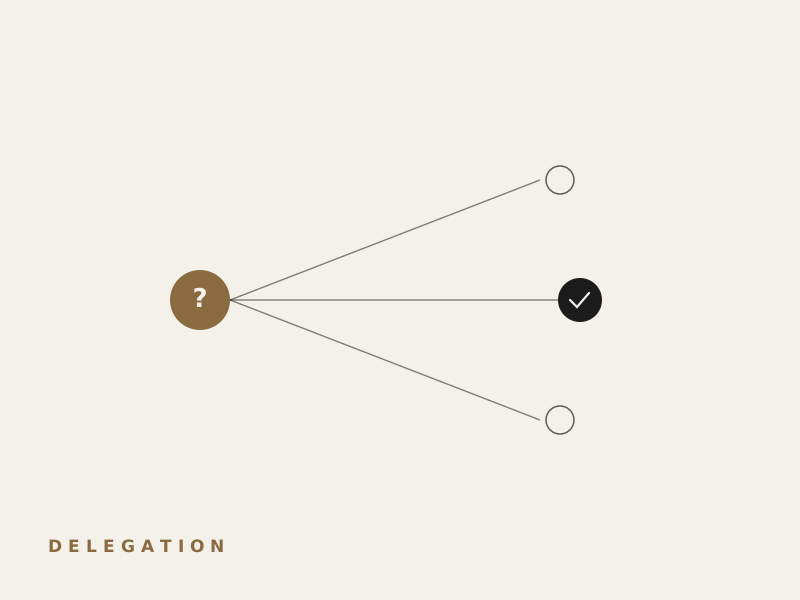
Communication is still underrated. Most delegation fails before execution even starts. When the outcome isn't clear in the manager's mind, it has no chance of being clear in the team's hands. This is where the gap begins.
The instruction goes out. The task gets logged as "delegated." But delegated and understood are not the same thing, and the distance between them is where performance quietly erodes.
When the outcome isn't clear in the manager's mind, it has no chance of being clear in the team's hands.
There's a meaningful difference between handing someone a task and handing someone an outcome. A task says: do this. An outcome says: here's what we're working to see as an end result, here's why it matters, and here's what good looks like when it's done.
One produces compliance. The other produces judgement. And it's judgement that lets a team act correctly when circumstances shift — which they always do.
Leaders who delegate outcomes build teams that can think without them in the room. Leaders who delegate tasks build teams that wait to be told.
None of this looks like poor leadership in the moment. It looks like being busy. It looks like trusting people to "just get it." The cost only shows up later, in the output. Then leaders want to hide behind what they presume to be "common sense."
When delegation fails, the instinctive correction is tighter control: more check-ins, more oversight, more detailed instructions next time, another SOP. It feels like accountability. It's usually the opposite.
Tighter control without clearer communication doesn't close the gap. It adds friction, signals distrust, and keeps the manager in the loop on every decision and every move. It starts to look and feel like micromanagement — the opposite of what delegation is meant to achieve. Real accountability starts upstream, at the point the outcome was defined, or wasn't.
The question worth asking, before deciding the team underperformed, is whether the outcome was ever clear enough to hold them to. Most of the time, the answer changes the conversation entirely — from managing people harder to leading them better.
Retention
High staff turnover is rarely about pay. Here's what really drives good people out.
 Self-Leadership
Promoting on technical skill alone creates a predictable leadership gap.
No obligation. No generic proposal. Just a direct diagnostic discussion about what's actually happening in your business.
Take the DiagnosticQuick Diagnostic Enquiry